The Friedrich Barbarossa Memorial: Where the Crusade Ended
On the banks of the Göksu River, 9 kilometers west of Silifke, stands a modest monument with a bilingual inscription—in German and Turkish. The Frederick Barbarossa Memorial marks the spot where, on June 10, 1190, the life of one of the most powerful rulers of medieval Europe—Frederick I Barbarossa, Holy Roman Emperor—came to an end. He led a massive army on the Third Crusade and was already close to his goal when the crossing of a small mountain river brought everything to an abrupt halt. Today, the Frederick Barbarossa Memorial is a place of historical remembrance, a pilgrimage site for German tourists, and a quiet spot by the river where history feels entirely different than in museum halls.
History and Origin of the Frederick Barbarossa Memorial
Frederick I Barbarossa is one of the key figures of medieval Europe. Emperor of the Holy Roman Empire from 1155, he ruled for nearly four decades and transformed the empire into the dominant power of Central Europe. He earned the nickname “Barbarossa”—“Redbeard”—from the Italians due to the distinctive color of his beard. By the time of the Third Crusade, he was about 67–70 years old—by 12th-century standards, a man of very advanced age—and yet he personally led the army.
The Third Crusade (1189–1192) was organized in response to Saladin’s capture of Jerusalem in 1187. Three great monarchs took part in it: Frederick Barbarossa, the French King Philip II Augustus, and the English King Richard I the Lionheart. Barbarossa chose a land route through the Balkans and Anatolia, leading an army of many thousands—one of the largest ever assembled in Western Europe for a campaign to the East.
The journey through Anatolia proved exhausting. The Seljuk sultan Kılıçarslan II granted free passage—the commemorative inscription refers precisely to this “friendly agreement.” The army had crossed most of the peninsula and had already entered Cilicia when, in June 1190, it halted before the Saleph River—the very same river that is called Göksu today.
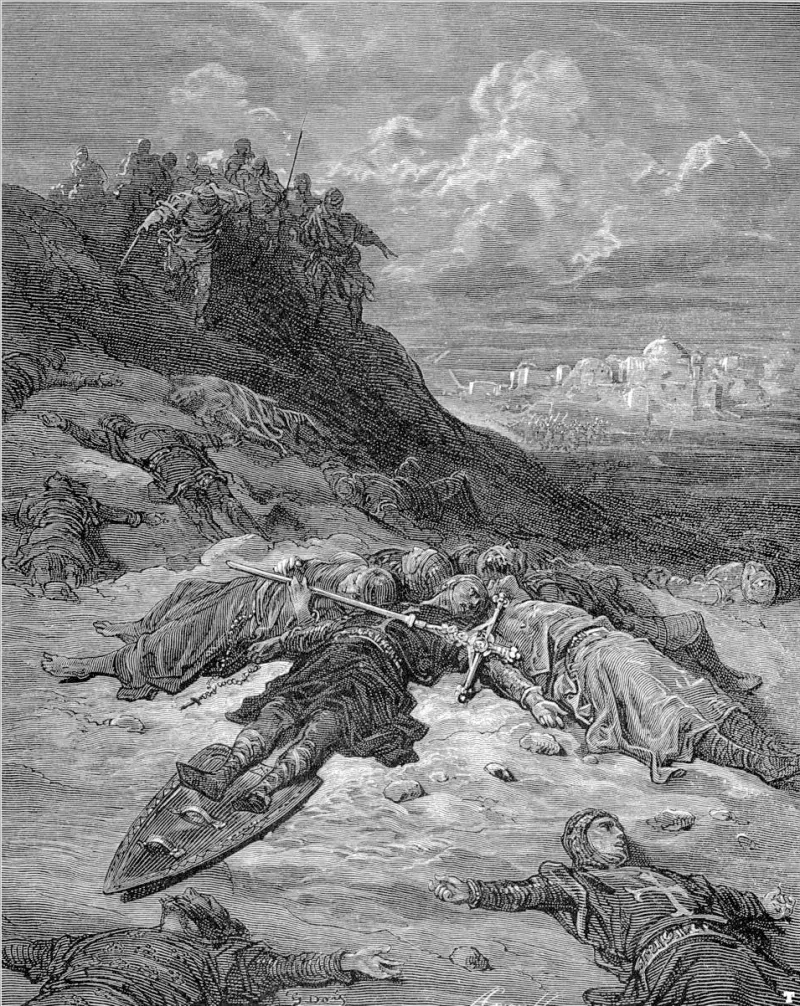
There are several versions of what exactly happened on June 10, 1190. According to one, Barbarossa drowned while wading across the river: his horse stumbled, and the elderly emperor was unable to swim out fully armed. According to another, he fell from his horse and was swept away by the current. Historical sources differ on the details, but they agree on one thing: the great crusader perished in the waters of a small mountain river on his way to Jerusalem.
Barbarossa’s death was a catastrophe for the campaign: most of his army turned back or scattered. Only a small detachment continued by sea and joined forces with Richard and Philip. At that time, the region was effectively under the control of the Armenian Kingdom of Cilicia—not the Seljuk Sultanate, as the memorial inscription suggests.
The first memorial stone at the site of the emperor’s death was erected by the German Embassy in 1971. In 2012, a larger monument featuring a full-scale statue of the emperor was unveiled on Highway D715. Its location was personally determined by the German ambassador, Prof. Pascal Hector. However, just one year after its unveiling, the statue disappeared—leaving only the pedestal behind. The circumstances of its disappearance have not been officially established.
Architecture and What to See
Pedestal and inscription
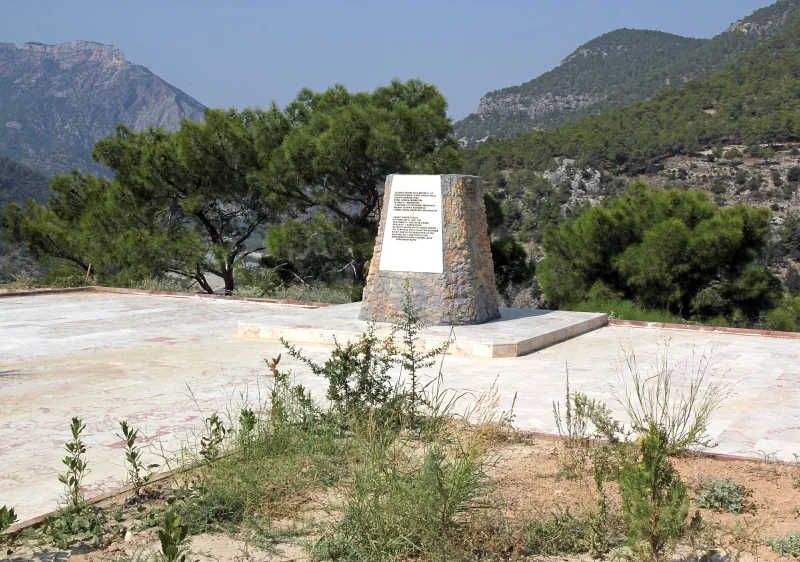
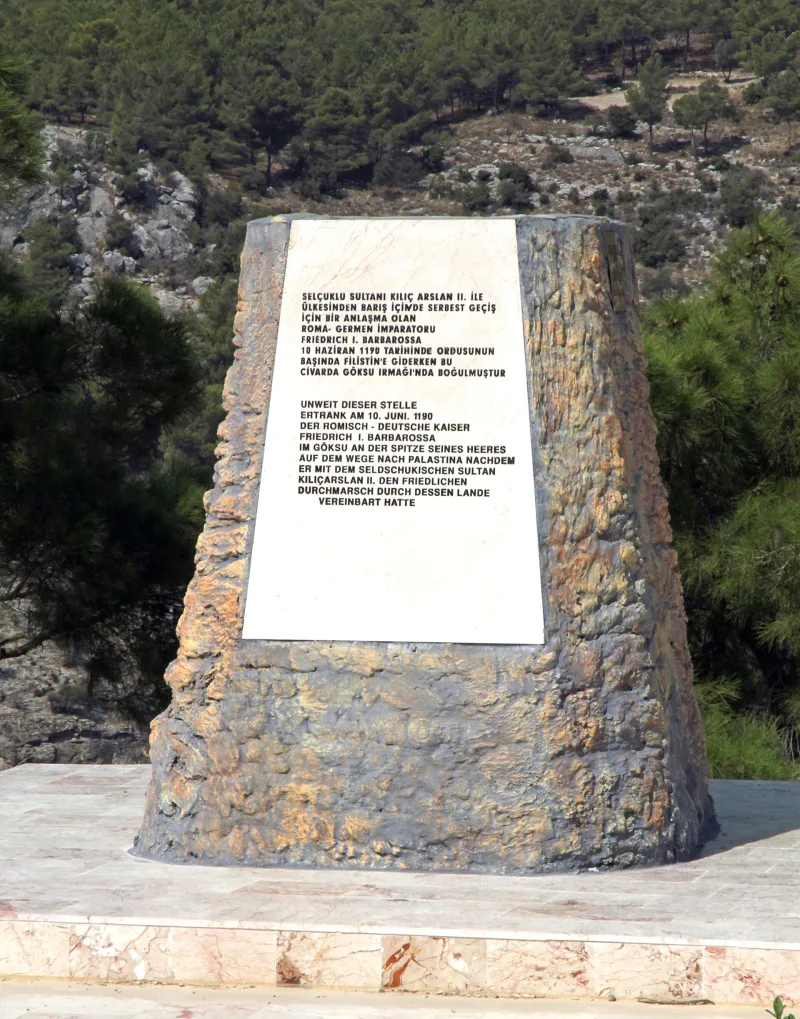
Today, the memorial consists of a pedestal made of hewn stone, upon which the statue of the emperor once stood. A bilingual inscription (German and Turkish) reproduces the text of the 1971 plaque: “Emperor Frederick Barbarossa of the Holy Roman Empire, who had a friendly agreement with the Seljuk Sultan Kılıçarslan II regarding free passage, drowned in the Göksu River near this place while leading his army to Palestine.” The inscription contains a historical inaccuracy (the region was Armenian at the time, not Seljuk), but conveys a message of reconciliation.
View of the Göksu River and the village of Ekşiler
The monument stands on a hill offering a view of the Göksu River valley and the village of Ekşiler on the opposite bank. The river here is narrow, with a fast current and clear mountain water—it is hard to believe that this unremarkable stream altered the course of medieval history. The landscape is typical of Mersin Province: low mountains, olive groves, and the whitewashed houses of the village. The busy D715 highway runs nearby.
Historical Perspective: Silifke Fortress
Nine kilometers to the east lies Silifke—a city with ancient roots and a well-preserved medieval fortress atop a hill. A visit to Silifke Fortress naturally pairs well with a visit to the memorial: here you can see what the fortified territory looked like through which Barbarossa’s army passed. The town also has a decent archaeological museum.
Interesting Facts and Legends
- Barbarossa’s death in a small mountain river gave rise to an entire cultural tradition in Germany. According to a legend recorded in late medieval chronicles, Barbarossa did not die but sleeps in the Kyffhäuser Mountain in Thuringia and will rise when Germany is in danger. His death by the Göksu River is thus interpreted as a sleep, not death.
- The statue of Barbarossa, which was ceremoniously unveiled in 2012, disappeared just a year later—its fate remains officially unknown. This mysterious ending lends the memorial a special historical irony.
- Local historian Dr. Mustafa Erim proposed erecting a statue of the Seljuk sultan Kılıçarslan II, mentioned in the inscription, next to the memorial—as a symbol of Turkish-German historical dialogue.
- The Third Crusade, despite Barbarossa’s death, ended with the signing of a treaty in Jaffa: Jerusalem remained under Saladin’s control, but Christians were permitted to make pilgrimages to the Holy City.
- The text of the memorial inscription contains a historical inaccuracy: in 1190, the region was controlled by the Armenian Kingdom of Cilicia, not the Seljuk Sultanate. This correction is also noted by the authors of the Wikipedia article.
How to get there
The Friedrich Barbarossa Memorial is located on Highway D715, approximately 9 kilometers west of Silifke in the province of Mersin. The nearest major airport is Adana Sakirpasa (ADA), from which Silifke is about 100–110 km away via Highway D400 westward, then south on D715.
By car from Adana or Mersin: follow the D400 to the turn for Silifke, then take the D715 toward Taşucu. The memorial is visible on the right side of the road, above the river. Parking is informal—along the roadside.
From Silifke itself, you can reach the memorial by taxi (10–15 minutes) or by minibus toward Taşucu. Public transportation from Adana to Silifke runs regularly—several times a day from the bus station (otogar). Silifke is connected to Mersin and Adana by direct bus routes.
Tips for travelers
A visit to the memorial takes no more than 20–30 minutes and can easily be combined with a tour of Silifke: there is a 12th-century fortress, ancient ruins, and a small museum. If you have time, continue west along the coast—after a few kilometers, the Mersin coastline begins with the beaches at Kızkalesi.
The best seasons to visit are spring and fall. In summer, the Göksu Valley is hot, and Highway D715 is congested with tourist traffic. In winter, the memorial is open, but the road can be slippery after rain.
For German tourists, this place holds special historical significance—a sort of pilgrimage in the footsteps of the Third Crusade. For Russian-speaking travelers, the memorial is interesting as a rare point where Western European medieval history intersects with the Turkish Mediterranean: a place where a grand design clashed with the indifference of nature. The Friedrich Barbarossa Memorial is not a monumental structure, but its symbolic significance is disproportionately great relative to the monument’s actual size.